collective memory is everything I don't remember: Memories that are not our own
The exhibition project presents the works of seven Latvian women artists of the millennial generation, whose work, visual language and communication strategies are influenced by or directly stem from the phenomenon of collective memory. At the same time, the project also deals with the situation when collective and individual memory intertwine, influence and co-constitute each other.
The generation of these artists is very specific in relation to the location and time in which they live and create. These are authors who were born directly in the Soviet Union, which, however, ceased to exist when they were in preschool. During their late teens, Latvia joined the European Union, which brought with it many new things and started an era of innovation. The artists therefore experienced completely determining transformations in the first third of their lives, which they experienced not only through societal changes, but also through changes within their closest friends and family. At the same time, these are artists who, through their family members or close people and their collective memory, are closest to the realities of the 20th century, which in the Latvian context is very complicated – full of clashes of ideologies, damaged memories and narratives of tangled identities.
An important aspect of the millennial generation is also the transition from the analog era to the digital and online era. As well as the shift to the period of globalization of topics, when situations that move the world are shared and resolved in real time, without too much distance or perspective that would help anchor or, for example, legitimize them. Ultimately, this is a generation of artists that is full of references and inspiration regarding the motifs of memory – collective and personal memory, identity or time and their relevance. In this project, Latvian authors are considered as bearers of the mentioned themes, but identical tendencies and approaches can be found across the entire Eastern European environment.
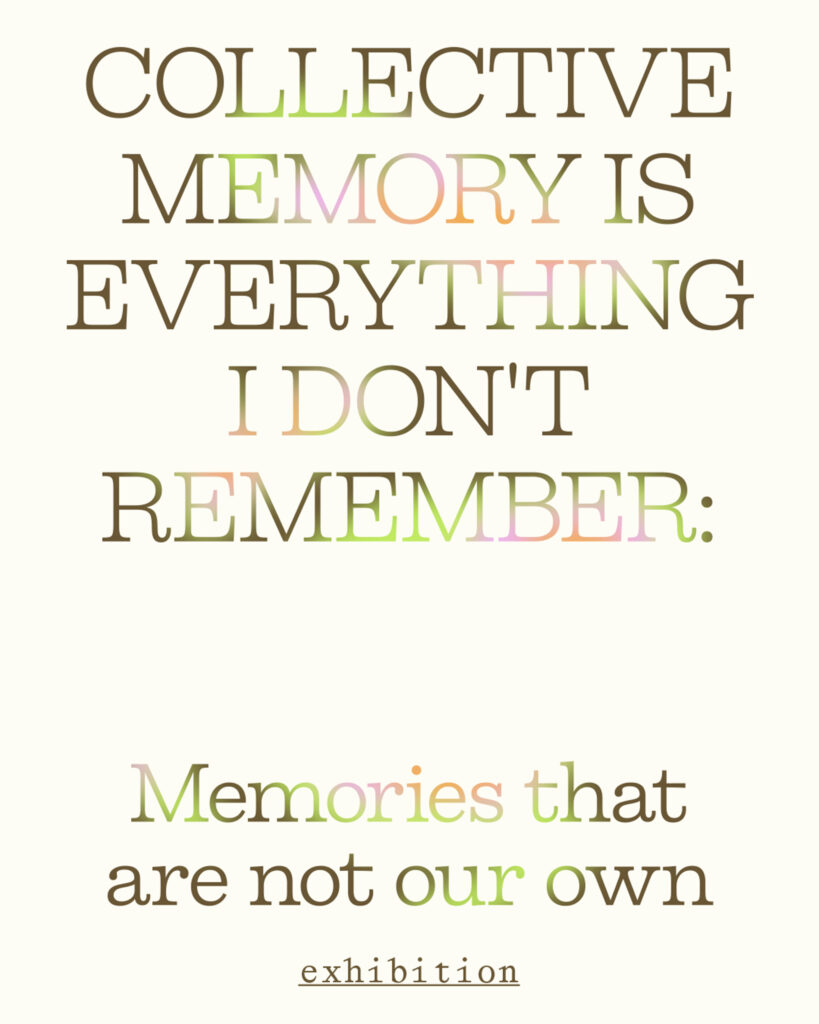
The exhibition project presents the works of seven Latvian women artists of the millennial generation, whose work, visual language and communication strategies are influenced by or directly stem from the phenomenon of collective memory. At the same time, the project also deals with the situation when collective and individual memory intertwine, influence and co-constitute each other.
The generation of these artists is very specific in relation to the location and time in which they live and create. These are authors who were born directly in the Soviet Union, which, however, ceased to exist when they were in preschool. During their late teens, Latvia joined the European Union, which brought with it many new things and started an era of innovation. The artists therefore experienced completely determining transformations in the first third of their lives, which they experienced not only through societal changes, but also through changes within their closest friends and family. At the same time, these are artists who, through their family members or close people and their collective memory, are closest to the realities of the 20th century, which in the Latvian context is very complicated – full of clashes of ideologies, damaged memories and narratives of tangled identities.
An important aspect of the millennial generation is also the transition from the analog era to the digital and online era. As well as the shift to the period of globalization of topics, when situations that move the world are shared and resolved in real time, without too much distance or perspective that would help anchor or, for example, legitimize them. Ultimately, this is a generation of artists that is full of references and inspiration regarding the motifs of memory – collective and personal memory, identity or time and their relevance. In this project, Latvian authors are considered as bearers of the mentioned themes, but identical tendencies and approaches can be found across the entire Eastern European environment.
The authors represented in the exhibition are Ieva Balode, Vika Eksta, Ieva Kraule-Kūna, Liene Pavlovska, Diana Tamane, Krista Vindberga (Dzudzilo), and Elīna Vītola, who work with a variety of media and techniques, such as objects, drawing, photography, analogue film or site-specific installations. The themes presented in the exhibition will be both family motifs or intimate stories, as well as themes arising from the socio-economic sphere or work with artifacts in public space or myths woven into the landscape.
EXHIBITION BROCHURE (English)
EXHIBITION BROCHURE (Czech)
6. 3. – 5. 4. 2026 at H40 space in Prague
Hala 40 – space of Chemistry Gallery
Bubenské nábřeží 306/13, Prague 7
opening hours: Wed, Thur, Fri, Sun 15–19, Sat 11–19
admission is voluntary
Diana Kněžínková
curator
Anna Vartecká
consultation
Nikola Iljučoková, Barbora Tomová
graphic design
Elis Kondelíková
photography
Šimon Kotmel
transport
Ondřej Sýkora
proofreading
Michaela Ritter Konárková
translation
public program of the exhibition – Collective memory is everything I don't remember: Memories that are not our own
Short film evening
films of Ieva Balode, Vika Eksta, Diāna Tamane, Krista Vindberga
6. 3. 2026 18:00 at Anežka (Anežská 12, Prague 1)
Artist talk with Krista Vindberga
7. 3. 2026 16:00
So they said.
performance of Darja Lukjanenko and Anna Solianyk
11. 3. 2026 18:00
Discussion with Czech and Slovak Vietnamese creators.
20. 3. 2026 18:00
Latvia – a country that sings, dances and paints
(Not only) travel lecture
24. 3. 2026 18:00
Collective Memories in Exhibition
movement-based workshop led by Orkun Türkmen & Barbora Türkmen
25. 3. 2026 18:00
Guided tours
with the exhibition curator
18. 3. 2026 18:00
1. 4. 2026 18:00